When your key will not turn, do not force it. Try these safe moves. Take pressure off the steering wheel, wiggle the key gently, check your gear is in Park, test the battery, and look for key wear. These steps cover the steering wheel lock, the battery, and the ignition. They protect parts and save time.
Why your key will not turn
Let’s keep this simple. Your key, the lock, and the car have to agree. If one says nope, you get a stuck key. Here is what often happens.
- The steering wheel lock is loaded. The wheel pulled tight to one side jams the key.
- The shifter is not fully in Park or Neutral. The interlock says no.
- The battery is weak. The security and shifter systems sit asleep and block the cylinder.
- The key is worn or bent. The cuts do not match the pins any more.
- The ignition lock cylinder is sticky or dirty. Dust, pocket lint, and old lube can gum it up.
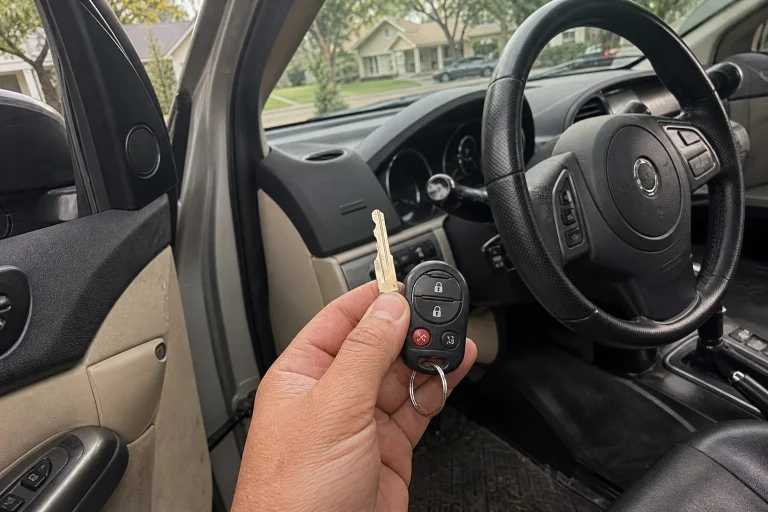
- The key has a chip and the ring that reads it is not happy. The security light may flash.
- A front wheel is pinned against a curb. The lock has extra load on it.

A quick safety check before you start
- Set the parking brake. Keep the car from rolling.
- Turn off fans and loud music. Listen for clicks and beeps.
- Keep fingers away from the airbag area while you tug the wheel.
- Do not pull so hard that you strain your neck. Slow and steady wins this race.
Start with steering wheel lock relief
Picture this. You park by the curb on Westheimer, wheels turned right, late for a coffee. You hop back in, turn the key, and it stops cold. That lock is doing its job a little too well. Here is how to release it without damage.
- Put the key in. Do not force it.
- Put light turning pressure on the ignition key. Only as much as you would need to turn a door key.
- With your other hand, rock the steering wheel left and right in short moves. Do not yank hard.
- Find the side that gives a tiny bit. Hold light pressure on the key and turn the wheel toward the side with give.
- Once the load drops, the key should turn and unlock the wheel.
Pro tip with a smile. Think of it like opening a pickle jar someone closed a bit too tight. You do not need a superhero grip. You need the right angle and steady hands.
Check your gear selector and brake switch
If the car thinks you are not in Park, it can lock the key and block the start. Sometimes the shifter looks like it is in Park, but it is just shy of the notch.
- Step on the brake pedal. Keep pressure steady.
- Move the shifter fully into Park. Listen for the click.
- Try Neutral. Many cars let you start in Neutral too.
- If the brake lights do not turn on, the brake switch may be the issue. Press the pedal firm and see if that helps the interlock wake up.
Give the battery a quick check
A weak battery is sneaky. It may light the dash, but still fail to feed the security and shifter locks.
- Turn on the headlights. Are they bright or dim
- Hit the horn. Is it strong or weak
- Watch the dash lights while you try to turn the key. If lights fade fast, the battery may be low.
- If you have a tester, 12.4 to 12.7 volts is healthy. Under 12.2 can mean trouble.
- Try a jump from a safe source. If the key turns after a jump, the battery was the hold up.
Look closely at the key
Keys wear like old sneakers. A tiny bend can throw off the match.
- Lay the key on a flat surface. Does it wobble or curve
- Compare it to a spare. Do the cuts look the same
- Clean lint from the grooves with a soft brush. Do not use a knife. We are not whittling a stick.
- If the head has a chip, keep it dry and clean. Tape or glue on the head can block the signal.
Give the ignition a little love
Do not flood the lock with oil. That invites dirt to a party. If things feel sticky, a tiny puff of lock safe dry lube can help. Keep it small. If you are not sure what product is safe, skip this step and try the steering wheel and shifter moves first.
How Houston weather plays a part
Heat makes metal expand. That close fit inside the ignition can feel tighter on a 100 degree day on I-45. Humidity adds grit and moisture. Quick rain can push damp air into tiny spots. A rare cold snap in January can shrink parts and harden old grease. All this can make a borderline lock stick. A clean key and gentle moves can cut through that drama.
What we usually see in Houston, TX
- Drivers parked with wheels cranked against a curb near The Heights, key will not turn until the wheel is relaxed.
- Weak batteries after a hot week on the Loop, security light on, key stuck until a jump wakes things up.
- Worn keys on older trucks, owner uses the spare and the problem vanishes.
Step by step safe moves that work
Use these in order. Talk to your car like a friend. It helps keep your own cool.
- 1. Relax your grip
Place the key in and rest your hand. No white knuckles. Try a gentle turn to the On spot. If it resists, stop. You are just testing. - 2. Release steering load
Hold light turn on the key. Rock the wheel left and right in short moves. Spend ten to twenty seconds finding the side that gives. It should click free. - 3. Check Park and Neutral
Press the brake. Move the shifter all the way to Park, then back to Neutral, then back to Park. Try the key each time. - 4. Wake the battery
Flip the headlights on and off. If they seem weak, ask a friend for a jump. Hook up safely following your car manual. Once powered, try the key again. - 5. Try the spare key
If you have one, try it now. A good spare can tell you a lot fast. - 6. Clean the key blade
Wipe it with a cloth. Brush the grooves. Avoid sprays unless lock safe and used in a tiny amount. Reinsert and try again. - 7. Look for the security light
If a key or chip issue is present, the security light may flash. Let it sit for ten minutes with the key in On, then try again. Some cars reset this way. - 8. Light tap method
With the key in, use your finger tips to tap the key head lightly while turning gently. Tiny taps can settle pins. No hammers. No pliers. - 9. Check the front wheels
If they are jammed against a curb, roll the car a half inch by easing pressure off the brake while in Neutral, if safe and with the parking brake set after. Then try again. - 10. If you feel scraping or the key will not go in
Stop and call a pro. Forcing it can break the key or pin the cylinder.
Troubleshooting quick list
- If the steering wheel will not move, turn the key lightly while rocking the wheel toward the side with play.
- If the key turns part way then stops, ease off, return to start, and try again while moving the wheel.
- If the key will not go all the way in, inspect the key for burrs, clean the slot gently with air, do not push debris deeper.
- If lights are dim and the key is stuck, charge or jump the battery, then try to turn to On and back to Lock.
- If the shifter is stuck in Park and the key is trapped, press the brake hard, use the shift release button if present, move to Neutral, then try the key.
- If the security light flashes, use the spare key or try a ten minute reset cycle, then start.
- If the key turns but the car does not crank, the ignition switch or starter may be the issue, call a locksmith or mechanic.
- If the key turns but will not come out, set the parking brake, move to Neutral then back to Park, then try to remove.
What not to do
- Do not force the key with pliers. That breaks keys.
- Do not hammer the key. That dents pins.
- Do not flood the lock with oil. That traps dirt.
- Do not wiggle so hard the column creaks. Gentle is the rule.
- Do not try to bypass security with random tricks you saw online. That can lock it down harder.
A quick story from the lot
A customer near the Galleria called and said, I turned the key like I always do. It said nope. He was sure the cylinder was toast. We checked the wheel. It was pinned left against a curb. A little wheel wiggle, a little key pressure, click. The key turned like butter. He laughed and said, I swear it had it in for me. The car just wanted a small nudge.
When it is not the key or the wheel
Sometimes the block lives deeper.
- Shifter interlock solenoid is stuck. You press the brake, but the lock does not release.
- Brake switch failed. The car does not see your foot on the pedal.
- Ignition lock cylinder pins are worn. The key cuts match poorly.
- Aftermarket key or copy is off a bit. A dealer code cut or locksmith code cut may fix it.
- Electrical ignition switch is failing. Key turns, but signals do not pass.
- Column parts are damaged from a past force attempt.
In these cases, stop early. A trained tech can free it without harm and can rekey or replace parts if needed.
Care and prevention that pays off
Weekly
- Keep keys light. Heavy keychains pull on the lock. Move store cards off your car key.
- Keep the key clean. Wipe mud or beach sand off the blade.
Monthly
- Test your battery. Look for clean terminals. Brush off any white crust.
- Sit in the car and turn the wheel full left and right while parked. Feel for any stiff spots.
Yearly
- Ask for a spare key cut from factory code, not a copy of a copy.
- Have a locksmith inspect a sticky cylinder before it gets worse.
- Check door and trunk keys too if you have them. Wear shows in families.
Common beliefs and the real scoop
- People say more force will free a stuck key. The real scoop is more force often snaps the key. Use gentle moves and relieve wheel load.
- People say spray a lot of oil in the ignition. The real scoop is heavy oil grabs dirt. A small amount of lock safe dry lube can help, but keep it tiny.
- People say a weak battery cannot stop a key from turning. The real scoop is many cars tie the lock and shifter to power. A low battery can block you.
- People say all keys are the same. The real scoop is chip keys and worn copies behave very different from a code cut spare.
Light humor break
Your key is like a picky cat. It wants the bowl in the right spot, the fresh water, the quiet room. Give it the gentle touch and it will purr.
Simple tools to keep in the glove box
- Clean microfiber cloth for the key.
- Small lock safe dry lube. Read the label for ignition use.
- A basic 12 volt tester or jump pack.
- Flashlight to see the key slot and shifter release.
Signs you should call a pro right now
- The key blade bends or cracks.
- You feel sharp grinding when inserting the key.
- The key is stuck half way in or half way out.
- The security light stays on with a good battery and good key.
- You tried the steps above and nothing changed.
Small checklist for chip keys
- Keep the head clean. Do not wrap it in foil or tape.
- Do not store it near magnets for long.
- If the car has a spare chip key, test it once a month. Make sure it works.
Extra notes for older trucks and SUVs
Older gear can have more play in the wheel and shifter. That can load the lock more often. Put the car in Park, set the brake, then let the wheel settle before you pull the key. A two second pause here can save you twenty minutes later.
How rain and floods play in
Houston can get fast rain. Water and grit can ride in on your key. Wipe the key before inserting. If your car saw flood water, get the ignition checked. Water can rust pins and the reader ring for the chip.
Security light clues
- Flashing fast with no start can mean the chip is not read.
- Solid light with key stuck can point to an interlock fault.
- No light and no crank can lean toward a battery or switch issue.
Little dialogue to keep calm
You say, Turn please.
The car says, Give me a wiggle on the wheel and we will talk.
You say, Fine, I can do that.
The car says, Click, thank you.
FAQs
Q: Why is my key stuck and the steering wheel locked
A: The wheel likely loaded the lock when you parked. Hold light key pressure and rock the wheel toward the side with a little give. It should release.
Q: Can a dead battery make the key not turn
A: Yes. Many cars need power for the shifter and lock. If lights dim fast, jump or charge the battery and try again.
Q: My key goes in but does not turn. What should I try first
A: Try the steering wheel wiggle with light key pressure. Then check Park and Neutral. Then test the battery and try a spare key.
Q: Is WD 40 safe in an ignition
A: Flooding the lock is not a good plan. Heavy oils grab grit. A tiny amount of lock safe dry lube can help. If unsure, skip and call a pro.
Q: The key turns but the car will not start. Is that the same problem
A: That can be a bad ignition switch, a starter issue, or a security block. The cylinder may be fine. A quick test by a locksmith can pin it down.
Q: Can I tap the key to free stuck pins
A: Light finger taps while turning gently can help. No tools. No hard hits. If it resists, stop to avoid damage.
Q: When should I call a locksmith
A: Call if the key bends, if you feel grinding, if the key is half in, if the wheel will not budge, or if the steps do not change anything.
Q: Is it safe to tow with the wheel locked
A: Not without the right gear. Towing with a locked wheel can damage parts. Free the lock or use a flatbed with steering secured by a pro.
Q: How do Houston roads make this worse
A: Tight curb parking and hot sun load the wheel and dry out parts. Gentle moves and a good battery keep you rolling.
Why calling a local pro helps
A trained locksmith can free a stuck ignition without adding harm. We can match the cylinder to your key, cut a fresh spare by code, repair or replace worn parts, and check the chip reader. We come to you at home, on a job site, or in a lot. That saves a tow and saves time.
Final check before you get moving
- Does the key turn smooth now
- Does the wheel turn free
- Does the shifter move and lock in Park
- Does the security light act normal
If yes, take a short loop around the block. If not, reach out for help before things get worse.
If your key will not turn, Scorpion Locksmith can get you going without drama. We help drivers across Houston, from locked steering wheels to sticky ignition cylinders, weak batteries, worn keys, and chip key issues. On site service means less stress, less waiting, and no guesswork. Call (281) 623-1517 or visit https://scorpionlocksmithhouston.com/ for fast help today.